Where is it located and what function does the elbow have?
The elbow is the joint that joins the arm and forearm. It arises from the joint between the only long bone in the arm (the humerus) and the two forearm bones (the radius and ulna).
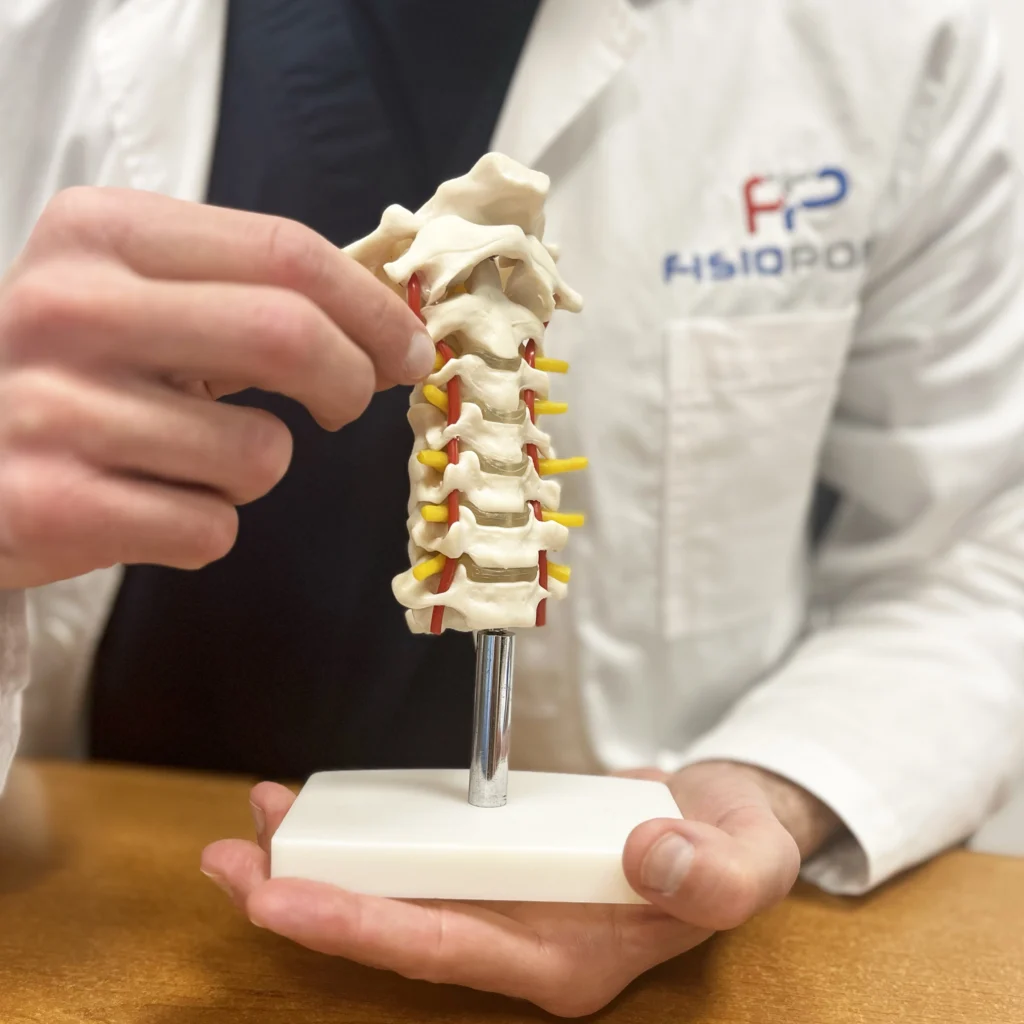
The distal part, i.e. the end part, of the humerus is wide and flat. In the centre we find an area, covered by cartilage (the condyle and trochlea), which articulates with the proximal part, i.e. the upper part, of the radius (lateral or external bone) and theulna (medial or internal bone). Above this area, the humerus has two bony protrusions: the lateral epicondyle and the medial epicondyle, also called the epitrochlea. From here, numerous muscles for the movements of the forearm, wrist and fingers of the hand insert.
The proximal, or superior, part of the radius, on the other hand, has a rounded, hollowed surface, which is called the capitulum, which articulates with the condyle of the humerus and the incisura of the ulna, forming another joint that joins the radius and ulna together.
The proximal part of the ulna consists of a large horizontal cavity that articulates with the trochlea of the humerus and a vertical projection, giving the ulna the shape of a hook, articulating posteriorly with the olecranon fossa of the humerus. The horizontal and vertical cavities together form the trochlear incisura.
Thanks to its anatomy and the muscles that take insertion on this joint, the elbow allows flexion and extension of the forearm on the arm. In addition, the proximal joint between radius and ulna allows gliding movements of one over the other, in turn allowing pronation and supination. This means that, while keeping the arm still, it is possible to turn the palm of the hand, together with the forearm, downwards and upwards.
What movements cause elbow pain?
As seen in the anatomy section, the elbow comes into play for training all the districts of the upper body, both with exercises for the arm's own muscles, such as the biceps (forearm flexor) and triceps (forearm extensor), and for muscles such as the pectoral and back muscles.
Prevention exercises for the elbow
In order to prevent very annoying pain, which can lead to a stop in training, here are some tricks to avoid overloading the elbow structure:
- to train the biceps, it is advisable to leave the elbow free and not to tie it to a bench, which could impede the physiological movements of all its structures;
- Furthermore, it is preferable to use two dumbbells or a moulded barbell. This avoids forcing as the forearm at the beginning of the movement is not on axis with the arm bone, but is slightly outwards, while at the end of the flexion it comes in line with the humerus;
- To reduce elbow overload, it is advisable to combine the movements of pronation in extension (palm facing down) and supination in flexion (palm facing up) when performing the exercises;
- During programming, it is always important to change the exercises, perhaps training the same muscle in different ways and with different equipment. In this way, you will avoid inflammation and send different stimuli to both the muscle and the central nervous system, in a practice that proves to be very training.
There may still be equipment in the gym that was used until recently, but which does not precisely respect the physiology and anatomy of the human body. Obviously technology is advancing and studies to improve training are also making great strides. To avoid getting into pain, my advice is to rely on the expert hands of a personal trainer who will be able to advise you at all times and adapt all the exercises according to the physical structure, which is different for everyone.
Text by Claudio Paolacci
Learn more by watching the videos on our channel YouTube


 English
 Italian