Crutches are an aid to movement, allow for proper body alignment and weight distribution, and are also a key element in the recovery process. They offer physical and psychological support to those who have to overcome obstacles in recovery after a lower limb injury. For proper walking, one must understand how to use them in different circumstances such as walking, climbing and descending stairs.
How to use crutches: methods and tips
Before approaching an everyday action such as climbing and descending stairs with crutches in a half-hearted manner, it is right to take all the precautions regarding which ones to choose. Each orthopaedic aid, in fact, has similar characteristics, but many can be customised according to one's problem and physical structure.
The first piece of advice for using crutches is to choose the right ones; there are several types, the two main ones being:
axillary crutches, which are the most common and provide support under the armpits
Canadian crutches provide support at forearm height
Two other fundamental factors to consider are:
Adjustable height. The correct height of the crutches is when the handles are parallel to the greater trochanter, which is the most protruding bone of the
femurThis prevents the elbows from being either too extended or too flexed and the shoulders from being in a position not conducive to good posture. For adjustment, it is essential to wear the shoes that you use most frequently and that have a non-slip sole.
Handles. They must be anatomically shaped and made of soft material, so that the crutches can be gripped comfortably and, above all, firmly. The hands must be able to rest perfectly across their entire surface so that any pain in the palm is avoided as much as possible.
How to stand and sit up using crutches?
It is important to take some precautions when getting up and sitting down from the chair, in particular:
To sit, you must use a stable and sturdy chair to avoid slipping and falling. Approach the chair and, once you reach the height of the seat, put down your crutches, staying on your healthy leg, then lean on the armrests with your arms and, holding your painful limb forward, slowly lower yourself and sit down.
To get up, try not to use crutches for support: the risk is that you will fall or put too much strain on your shoulders. If you use crutches, it is better to sit on chairs with armrests, which will be useful as a grip. If you have a plaster cast, a brace or a doctor's instructions to completely relieve the limb with difficulty, lean on the armrests of the chair, applying force to the healthy leg and then leaning on the crutches. Otherwise you run the risk of also moving the painful leg to get out of the chair before getting the crutches, putting more or less weight on the healthy limb.
Crutches and stairs: how to go up and down?
There are clear and well-defined methods for understanding what to do when we try to go up and down stairs with crutches. However, there is no need to worry too much, because it is not a very complex action, especially if we can count on the help of the handrail. Let's look at the cases both in the presence and absence of the handrail:
Climbing stairs with crutches and handrail: use only one cane, thus placing one hand on the handrail and the cane in the other. Step up with your healthy leg and hold the other limb slightly back. At this point, you can step forward with the crutch and bring your injured leg up onto the same step. Repeat the movement for each step.
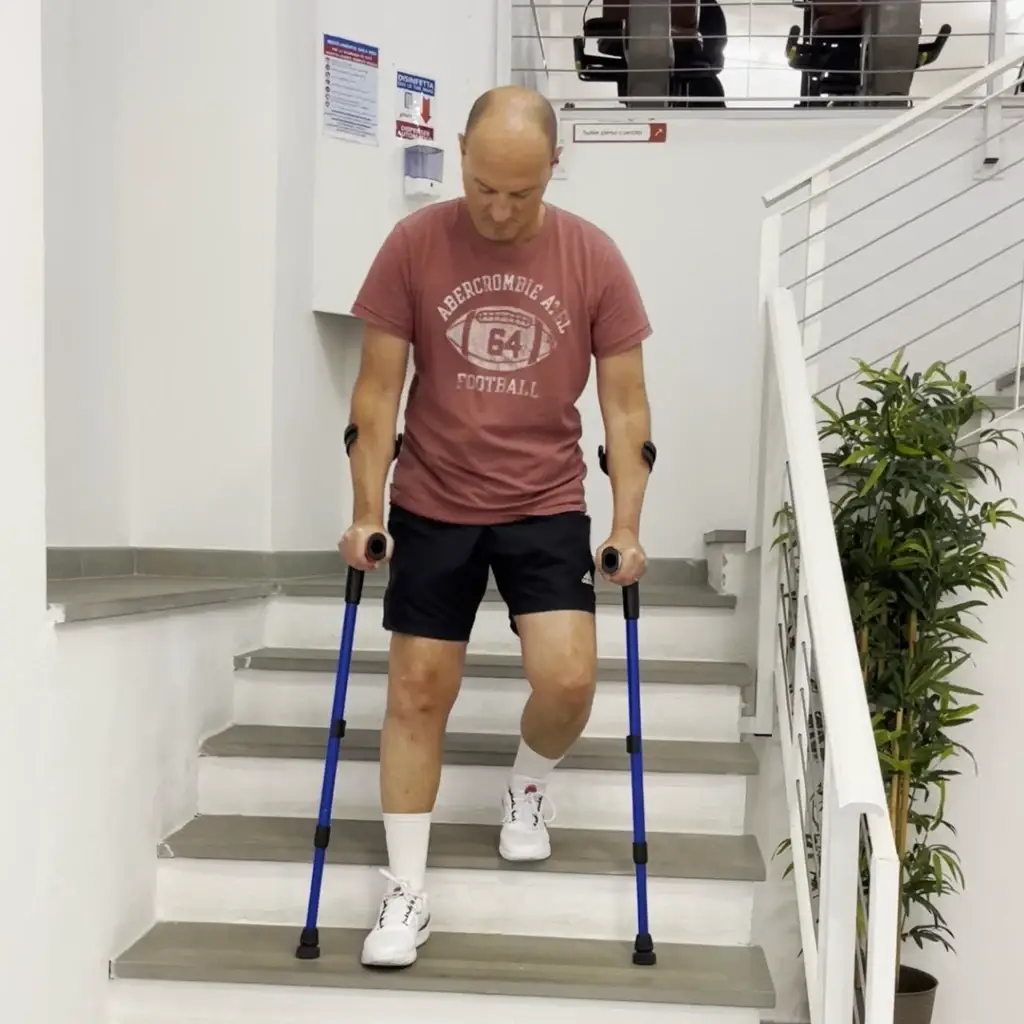
Descending stairs with crutches and handrail: with one hand grasp the handrail and bring the crutch together with the injured leg to the bottom step; while holding on tightly to the handrail, finally bring the healthy leg to the same step.
Climbing stairs with crutches and no handrail: step up with your healthy leg on the top step, keeping your weight on the sticks next to your injured leg; step forward with the crutches and, using the sticks, bring the other leg up
Descending stairs with crutches and no handrail: first bring the crutches and injured limb forward, then descend with the healthy leg
Generally speaking, the advice to bear in mind is to force the healthy leg first when going up the stairs, while bringing the injured one forward first when going down.
What tips to keep in mind to use crutches safely?
Climbing and descending stairs is not the only time to understand how to use crutches and move around safely. There are many other everyday circumstances that require a little extra attention to make sure you don't aggravate your condition. Here, then, is some useful advice:
avoid walking on mats :
-make sure that your body weight is offloaded onto your hands and not your armpits
-stop in case of dizziness or blurred vision
With regard to the load, other indications must be taken into account:
-unloaded limb: do not apply any weight on the diseased limb
-bearing load: apply only 10% of the weight on the sick limb, resting only the sole of the foot on the floor in order to balance the weight
-partial load: apply up to 50% of the weight on the sick limb
-full load: apply full weight on the injured limb
Text by Elisa Sordi
Learn more by watching the videos on our channel YouTube




 English
 Italian